Monday, 20 June 2011

Learn sanskrit - 1

Sanskrit is the combination of  all languages . There are many words in Hindi  which are similar in sanskrit.
Here the few  list of words in hindi as same as sanskrit:-

Hindi
Sanskrit
Meaning in English
नाम
Naam
नामः
Namah
Name
शत्रु
Shatru
शत्रुः
Shatruh
Enemy
स्वग्त
Swagat
स्वगतम्
Swagatam
Welcome
धन्यवाद
Dhanyavad
धन्यवादं
Dhanyavadam
Thank you
जल
Jal
जलं
Jalam
Water

These are some of the words similarly there are many others words too . 
Now let us see how to learn sanskrit 
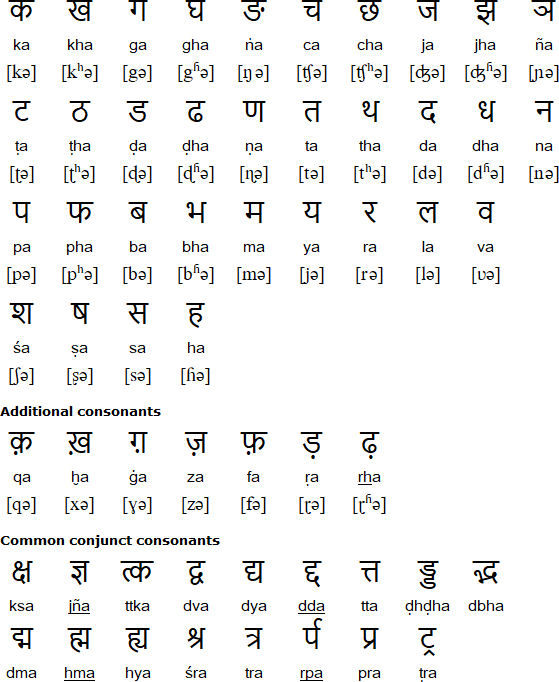
As we use A b c d in English for framing words similarly for reading and writting we in sanskrit we use the following:
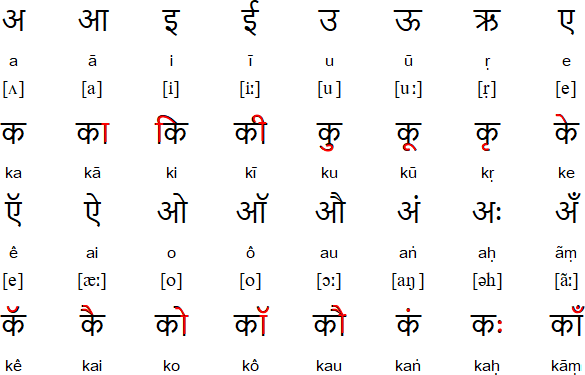
Hindi vowels and vowel diacritics

Consonants (व्यंजन)

Hindi consonants

Numerals

Hindi numerals and numbers from 0-10
Now let us see some simple words in sanskrit with their meaning 

अहं
Aham
Me
सः
sah
He
साः
Saah
She
पठति
Pathai
Reading/ book
पाठं
Patam
Lessons


Now lets frame few sentences from these 5 words :-

1.  अहं  पाठं  पठामि 
   
   (aham patham pathami)

  
   I am reading a book

2.  सः   पठति

    (sah  pathati)
  
    He is reading 

3.  साः  न  पठति 

    (saah na pathathi)

    She is not reading.


Sanskrit- Introduction


WHERE DID IT BEGIN?

  Sanskrit (saṃskṛtā; meaning 'perfected', 'refined', or 'polished') is the ancient sacred language of India. An official language of India, it is believed to be the oldest language of the world. There are still hundreds of millions of people who use Sanskrit in their daily lives, but despite these numbers, its cultural worth is unsurpassed.

The origin of Sanskrit can be accredited to the Vedic society. Vedic Sanskrit is believed to date back to the 2nd millennium BC, when knowledge was handed down through the generations verbally.

Mystic traditions of India ascribe a wholly sacred origin to the language, describing it as the language of the gods. When westerners began to take serious interest in the language some two hundred years ago, Sir William Jones, a British judge and orientalist, noted that Sanskrit possessed vocabulary and grammatical structures very similar to many other languages, including Greek, Latin, and even English. This discovery gave rise to the study of comparative linguistics, which groups the languages of the world into families. Sanskrit, along with about half of the world's languages, is a member of the Indo-European language family. This family has many branches and sub-divisions. Linguists place Sanskrit among the Indic languages of the Indo-Iranian branch. What common source may have given rise to this wide variety of related languages is entirely hidden by the mists of time.
  

HOW DID IT BEGIN?

  By 400BC a Hindu Indian grammarian by the name of Pāṇini had formally recorded rules of Sanskrit grammar. This is known as the Ashtadhyayi (Aṣṭādhyāyī).

The Ashtadhyayi consists of eight chapters, each divided into four sections, or ‘padas’. It characterises the difference between the language of the sacred texts and that of common street language. 3,959 rules of Sanskrit morphology have been set out, much in the way of a mathematical function, to define the basic elements of the language including sentence structure, vowels, consonants, nouns, and verbs. Pāṇini’s work is still used in the teaching of Sanskrit today.

Classical Sanskrit, as opposed to its more archaic ancestor Vedic Sanskrit, was in its height in the centuries AD. From it came a vast body of philosophical, scientific and religious knowledge, as well as Hindu scriptures and classical literature. These include works such as the Gita and Ramayana.
The Vedic Sanskrit is to Classical Sanskrit as Chaucer's English is to Shakespeare's English.